






 LIGHT
 7
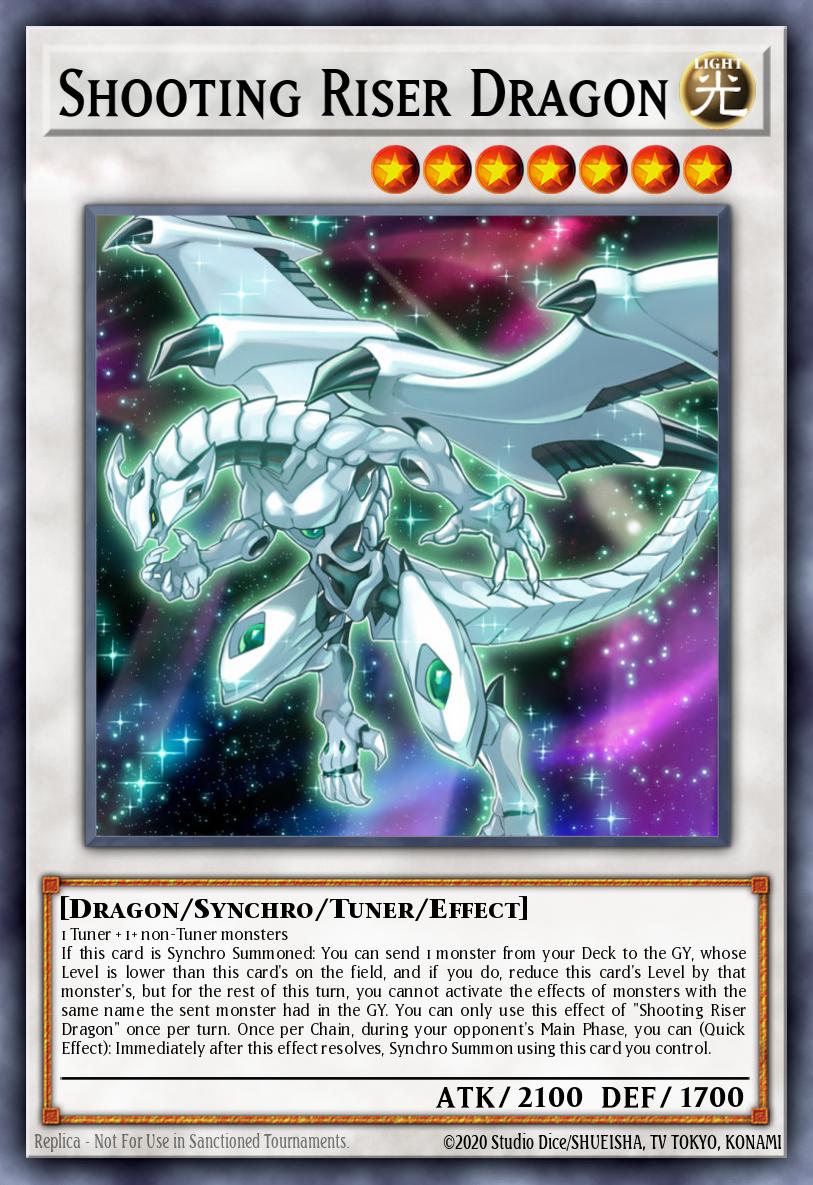
Shooting Riser Dragon
ATK:
2100
DEF:
1700
View:
7552
1 Tuner + 1+ non-Tuner monsters If this card is Synchro Summoned: You can send 1 monster from your Deck to the GY, whose Level is lower than this card's on the field, and if you do, reduce this card's Level by that monster's, but for the rest of this turn, you cannot activate the effects of monsters with the same name the sent monster had in the GY. You can only use this effect of "Shooting Riser Dragon" once per turn. Once per Chain, during your opponent's Main Phase, you can (Quick Effect): Immediately after this effect resolves, Synchro Summon using this card you control.
Shooting Riser Dragon — Power Evaluation
Final Score: 67 ± 6 · Confidence: Medium
- Intrinsic: 65 · Deck: 68 · Meta: provisional
- Primary role: Combo enabler · Secondary: Material body, Extender
Why it scores here
Shooting Riser Dragon converts a generic Tuner plus non-Tuner into a Level 7 Tuner body that dumps a monster from Deck and shrinks its own Level, which is what lets Tuner-heavy builds climb into higher-Level Synchro Monsters (Chaos Angel is its most common co-deck at 72%). Its second line is a once-per-Chain Quick Effect Synchro Summon during the opponent's Main Phase, giving the deck an on-board play on the turn it is not going. It is not a one-card starter and brings no negation of its own, so the score comes from being a cheap, universally splashable material/conversion piece (1 copy in 400/400 sampled decks across 60 archetypes) rather than from its 2100 ATK or Level. The turn-long ban on activating the sent monster's GY effects and the very thin combo sample (1 recorded combo with no role tags) keep it out of the top tier.
Axis scores
| Axis | Score | Evidence |
|---|---|---|
| Accessibility | 62 | Fully generic '1 Tuner + 1+ non-Tuner' materials and 400/400 sampled decks running it in the main deck at exactly 1 copy show it is live in any Tuner-heavy hand, though it must be Synchro Summoned and is not itself searched (Observed). |
| Combo & Conversion | 56 | The on-Summon Deck dump plus self Level reduction sets up a follow-up Synchro climb (Chaos Angel co-appears in 72% of its decks), but the single recorded combo carries empty role tags, so the ceiling of the line is unmeasured (Inferred). |
| Resource Economy | 54 | Converting two materials into one Synchro and then sending one monster from Deck is roughly card-neutral, and the clause forbidding activation of the sent monster's GY effects for the rest of the turn taxes that value (Verified). |
| Effect & Interaction | 55 | The only opponent-facing tool is the once-per-Chain Quick Effect Synchro Summon during the opponent's Main Phase, which still requires the remaining materials to already be on the field (Inferred). |
| Material Utility | 73 | As a Level 7 Tuner with no archetype restriction it is a clean Synchro material even if the on-Summon effect is negated, and its Level can be trimmed to anywhere from 2 to 6 (Verified). |
| Resilience & Flexibility | 55 | It operates from Deck, field and material zones and can act on the opponent's turn, but a single negation of the on-Summon effect leaves a plain 2100 ATK Level 7 body with no follow-up (Inferred). |
| Deck-Building Efficiency | 68 | One copy, no archetype lock and 60 distinct archetypes in the sample make it close to a free slot; the only real cost is the self-imposed lockout on the sent monster's GY effects (Observed). |
Calculation
Weight profile: 0.7 Combo enabler + 0.3 Material body. Intrinsic ≈ 65, Deck ≈ 68, Meta = provisional. Modifiers: Exceptional splashability (2); Self-imposed GY-effect lock (-2). Final formula: 0.40*Intrinsic + 0.60*Deck
Strengths
- Generic '1 Tuner + 1+ non-Tuner' Synchro materials make it usable in 60 distinct archetypes in the sample.
- On-Summon Deck-to-GY send plus self Level reduction enables climbing into higher-Level Synchro Monsters.
- Once-per-Chain Quick Effect Synchro Summon during the opponent's Main Phase gives an on-board play on the opponent's turn.
- Clean Level 7 Tuner body that remains excellent Synchro material even if its effect is negated.
- Runs as a single copy in 400/400 sampled decks (main deck, avg 1, max 1) with no garnet risk.
Weaknesses
- Must be Synchro Summoned — it cannot be placed on the field from hand and the evidence shows no searcher route.
- The rest-of-turn ban on activating the sent monster's GY effects is a genuine restriction on GY-reliant lines.
- Combos evidence is a single recorded combo with no starter/material/payoff role tags, so in-combo function is unmeasured.
- 2100 ATK and 1700 DEF are low for a Level 7 body; combat value is minimal.
- Provides no negation or removal by itself — the disruption comes only from whatever it turns into.
Counters / choke points
- Ash Blossom & Joyous Spring — negates the Deck-to-GY send, denying both the GY setup and the Level reduction.
- Effect Veiler / Infinite Impermanence — negate the on-Summon effect, leaving a plain Level 7 2100 ATK body.
- Called by the Grave — negates the sent monster in the GY, doubling down on the card's own restriction.
- Removal (e.g. Kaiju, Book of Moon) before the opponent's Main Phase stops the Quick Effect Synchro Summon.
Best use
Level-modulating Synchro Tuner used as a conversion/material piece to climb into higher-Level Synchro Monsters and to Synchro Summon on the opponent's turn. Decks: Kewl Tune, Elfnote, Power Patron, Synchron, Chaos Phantom, World Chalice. Suggested copies: 1.
Evidence & gaps
- Verified: Card text: Level 7 LIGHT Dragon Synchro Tuner, 2100 ATK / 1700 DEF, materials '1 Tuner + 1+ non-Tuner monsters'.; Card text: 'If this card is Synchro Summoned: You can send 1 monster from your Deck to the GY, whose Level is lower than this card's on the field, and if you do, reduce this card's Level by that monster's, but for the rest of this turn, you cannot activate the effects of monsters with the same name the sent monster had in the GY.'; Card text: the on-Summon effect is once per turn.; Card text: 'Once per Chain, during your opponent's Main Phase, you can (Quick Effect): Immediately after this effect resolves, Synchro Summon using this card you control.'; Card has no archetype, so the on-Summon GY-effect restriction is the only lock it imposes.
- Observed: 400/400 sampled decks run it, all in the main deck, at exactly 1 copy (avg 1, max 1).; It appears across 60 distinct archetypes; the largest homes are Kewl Tune (29%), Elfnote (11.2%), Power Patron (5.5%) and Synchron (3%).; Top co-deck partners are Ash Blossom & Joyous Spring (97.8%), Ghost Belle & Haunted Mansion (77.2%), Chaos Angel (72%) and Called by the Grave (71.8%).; combo data holds a single combo with 100% appearance share but 0% starter role, 0% material role, 0% payoff role and 0 starterCount (Infernity 'Shooting Quasar', power index 100, netCardAdvantage 6).; Guides place it under 'Staple' sections in Kewl Tune, Elfnote/Superheavy Samurai, Libromancer, Nordic and a Baronne de Fleur combo guide.; Usage statistics show 100% inclusion at 1 typical copy in the Chaos Phantom and World Chalice gameplay samples.
- Inferred: The Level-reduction line can make it a Level 2–6 Tuner, enabling a follow-up Synchro climb (consistent with Chaos Angel, a Level 10 Synchro, being its top non-hand-trap partner at 72%).; The Quick Effect gives a Synchro Summon during the opponent's Main Phase, functioning as an on-board interaction tool once the remaining materials are already committed.; Because its materials are completely generic, it stays a usable material body even when its on-Summon effect is negated.; The rest-of-turn ban on the sent monster's GY effects makes it a poor fit for decks that need that specific monster's GY effect the same turn.; Being a 1-of with no archetype restriction keeps the deckbuilding cost low regardless of which Tuner shell runs it.
- Data gaps: no banlist token — assumed 3 copies (unlimited) combo data contains only 1 combo and carries no role tags (starter role / searched-for role / material role / payoff role / end-board appearances all 0), so its in-combo function is unmeasured average starter count when present is 0 alongside a power index of 100, which is internally inconsistent and limits DeckResilience confidence no dated metagame sample is supplied, so Meta remains null/provisional guides evidence provides only co-card lists and generic staple-section snippets rather than card-specific play lines